
The True Cost of Private Jet Internet in 2026
Starlink rewrote the economics of the connected cabin, then rewrote the price list. Here is what the airtime, the antenna and the install actually cost — and the line items nobody quotes.
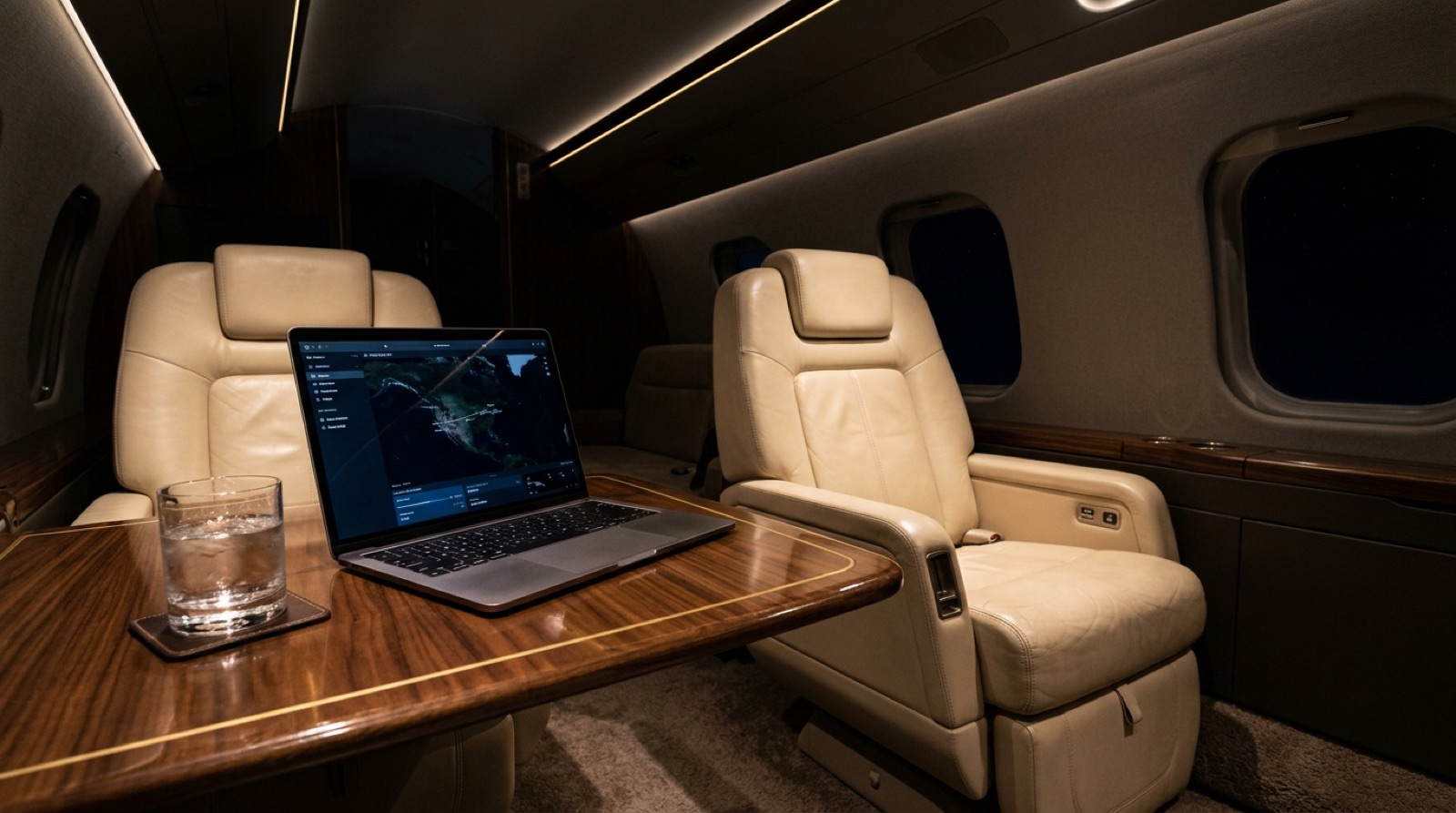
For two decades, the most expensive thing about flying privately was admitting the wifi didn't really work. That era is over. Starlink's Aero terminal — the flat-panel antenna now appearing on Gulfstreams, Globals and Falcons — carries an MSRP of roughly $145,000 for most business jets before installation, and delivers the kind of low-latency bandwidth that makes a video call at FL450 unremarkable. The catch arrived in March 2026, when SpaceX restructured its aviation pricing into speed-gated tiers: the Roam and Priority plans that opportunistic owners once ran aboard aircraft are now capped at 100 mph of ground speed, which is to say useless at cruise. If you fly a jet, you buy a jet plan.
Those plans are not subtle. Aviation tiers now start around $250 per month for light piston aircraft and $1,000 for light jets, rising to a 20 GB jet plan at roughly $2,000 per month — with overages at $100 per gigabyte — and an unlimited global jet tier at $10,000 per month, the de facto standard for corporate flight departments running mid-size and heavy iron. Meanwhile Gogo has pushed legacy air-to-ground customers toward AVANCE with a 25 percent price increase on old ATG plans from January 2026, and Viasat is retiring its Ku-band network in September 2026, offering up to $140,000 per aircraft to migrate owners onto Ka. The connectivity market is consolidating around three ecosystems, and every one of them prices for what the cabin is worth, not what the bits cost.
What the systems actually cost
The honest answer has three layers: the box, the install, and the airtime. The box is the number everyone quotes. The install is where it grows — a supplemental type certificate (STC), radome or fuselage work, downtime of ten days to three weeks, ideally folded into scheduled maintenance. A full Viasat Ka retrofit on a heavy jet, including removal of legacy Ku hardware, new terminals, wiring and certification, typically lands between $600,000 and $650,000. Starlink installs are lighter but still meaningful once STC, engineering and hangar time are included. Airtime is the layer that compounds: it is a five- to six-figure annual commitment for as long as you own the aircraft.
| Option | Hardware & install (typical, 2026) | Monthly airtime |
|---|---|---|
| Starlink Aviation (LEO) | $145,000 terminal + $50,000–$150,000 install/STC | $2,000 (20 GB, $100/GB overage) to $10,000 unlimited |
| Gogo AVANCE L5 (ATG, North America) | $100,000–$200,000 installed | ~$3,000–$8,000 depending on plan; legacy ATG +25% in 2026 |
| Gogo Galileo (LEO add-on) | $150,000–$350,000 installed | 50 GB/yr included with L5 unlimited; +25 GB for $3,500 |
| Viasat Ka / Jet ConneX (GEO) | $600,000–$650,000 full retrofit, ~3 weeks down | ~$8,000–$20,000+ by plan and region |
| Managed cabin network (the hidden line) | $15,000–$60,000 routers, firewall, segmentation | $1,000–$3,000 monitoring & support |
Ka, Ku and the LEO question
The alphabet matters less than the architecture. Legacy Ku-band is being switched off — Viasat's network sunsets in September 2026 — so anyone quoted a Ku system today is being sold a stranded asset. Ka-band GEO remains the choice for owners who want contractual service levels, global coverage commitments and OEM line-fit pedigree; Viasat Ka now holds STCs on more than twenty airframes and delivers comfortably north of 30 Mbps. LEO — Starlink today, Gogo Galileo's OneWeb-based service rising fast — wins on latency and raw speed, which is what principals actually feel on a video call. Increasingly the sophisticated answer is both: LEO for the cabin experience, GEO or ATG as resilience. We covered the experience side of this decision in our guide to private jet wifi and connectivity; the same logic governs the float, as our breakdown of yacht satellite internet costs makes plain.
The line items the brochure omits
The quoted system is rarely the delivered cost. Budget for the STC and engineering if your airframe is not already covered; for hangar downtime, which on a chartered or managed aircraft is lost revenue; for overage exposure on metered plans, where a single transatlantic of unmanaged iCloud backups can add four figures; and above all for the cabin network itself. The antenna is a pipe. What sits behind it — routers, access points, the firewall, the segmentation between the principal's traffic, guests, crew devices and the aircraft's own systems — is its own project, and the one most installers treat as an afterthought. An unsegmented cabin network is also the single largest security exposure on the aircraft, a theme we examine in depth in our superyacht and jet cybersecurity briefing.
The antenna is the cheapest part of the system. The judgement about what flows through it is the expensive part.
Buying it well
The pattern we see repeatedly: owners over-buy airtime in the first year — unlimited everything, on the installer's recommendation — then discover their actual mission profile would have been served by a metered plan and a properly configured network that doesn't let forty crew and guest devices stream in the background. The inverse error is rarer but worse: under-buying, then bleeding overage charges at $100 per gigabyte. Plan selection is an analytical exercise, not a brochure exercise, and it should be revisited annually as the LEO providers reprice.
Obsidian Helm advises principals and flight departments on exactly this — vendor-neutral plan selection, contract review before signature, cabin network architecture and segmentation, and discreet ongoing monitoring of what the aircraft actually consumes. Entirely remote, worldwide, under NDA, as part of our yacht, jet & estate practice and private concierge IT office. The connectivity vendors sell bandwidth. We sit on your side of the table.
Before You Sign the Connectivity Contract
A $4,999 Private Strategy Session — fully credited toward membership — reviews your aircraft's mission profile, quotes in hand, and tells you precisely which system and plan to buy, and which clauses to strike. Remote, worldwide, under NDA.
Request Your InvitationFrequently asked
How much does Starlink cost on a private jet?
The Starlink Aero terminal lists at about $145,000 for most business jets, with installation and STC work typically adding $50,000 to $150,000. Airtime in 2026 runs from roughly $2,000 per month for a 20 GB jet plan, with $100 per GB overages, up to $10,000 per month for unlimited global service on mid-size and heavy jets.
Why can't I just use a regular Starlink Roam plan on my jet?
Since SpaceX restructured aviation pricing in March 2026, standard Roam and Priority plans are speed-gated at 100 mph, so service cuts out at cruise speed. Aircraft now require dedicated Aviation plans, which start around $250 per month for light piston aircraft and scale to $10,000 per month for unlimited jet service.
Is Viasat or Gogo cheaper than Starlink for business jets?
Not usually. A full Viasat Ka retrofit typically costs $600,000 to $650,000 installed with monthly plans from roughly $8,000, while Gogo AVANCE L5 runs $100,000 to $200,000 installed but covers only North America, with legacy ATG plans rising 25 percent in 2026. Starlink generally wins on cost per megabit; GEO systems win on contractual service guarantees.
What are the hidden costs of private jet wifi?
The big ones are STC and engineering fees on uncovered airframes, hangar downtime of ten days to three weeks, data overages at up to $100 per gigabyte on metered plans, and the managed cabin network itself — routers, firewall, segmentation and monitoring — which typically adds $15,000 to $60,000 up front plus $1,000 to $3,000 monthly.