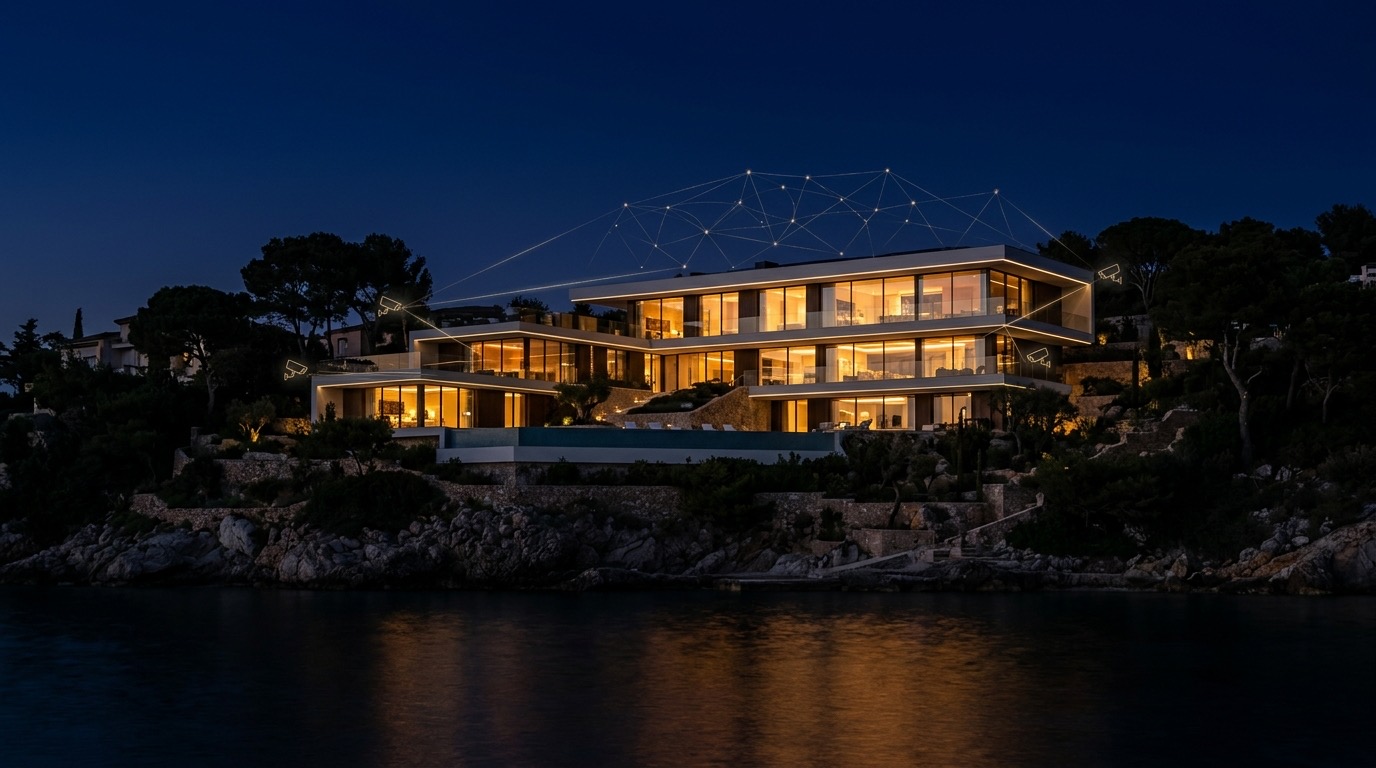
The Network a Villa Deserves
Connectivity is the one amenity guests notice only when it fails. A villa’s network should be engineered like a private bank’s — and felt like sunlight.

The global smart home market will pass an estimated $175 billion in 2026, and luxury whole-home systems now represent roughly a third of premium product demand. Yet the most common complaint heard in the world’s finest villas remains stubbornly analogue in spirit: the Wi-Fi falters by the pool, the screening room buffers, the video call from the study drops at the worst possible minute. The average household runs 22 connected devices; a serious estate — main house, guest pavilion, staff quarters, gym, spa, gatehouse — routinely carries three hundred, all contending for airtime on infrastructure chosen by an electrician.
The gap is not one of spend but of discipline. Consumer mesh systems, however expensive, were never designed for stone walls, low-emissivity glass, 4,000 square metres of footprint, or the security posture a principal’s household actually requires. Industry telemetry now records the average connected home absorbing around 29 attack attempts per day; a poorly designed villa network is therefore both an irritation and an open door.
Designed like infrastructure, not furniture
An estate network worth the name begins underground: fibre between buildings, not wireless hops that degrade in rain and foliage. It continues with an RF survey — a proper one, modelled against the architecture — so that access points land where physics dictates rather than where conduit happened to be. Enterprise-grade access points, centrally controlled, hand a moving iPhone from the terrace to the wine cellar without a flicker. Redundant internet paths — fibre primary, 5G or satellite secondary — mean a backhoe two villages away no longer silences the property. The result is the only acceptable outcome: nobody ever thinks about the network at all.
Four households, one property
Every villa is in truth several populations sharing a roofline: the family, their guests, the staff, and the machines. Each deserves — and security demands — its own segregated network. The owner’s segment carries the private devices and nothing else. The guest segment offers effortless, elegant onboarding and expires when the visit does. The staff segment reaches printers and household tools but never the family’s traffic. And the IoT segment quarantines the cameras, the AV racks, the pool controllers and the espresso machine, because — as we detail in securing the intelligent estate — those are precisely the devices attackers reach for first. Done well, segmentation is invisible; done at all, it is the difference between a network and a liability.
The finest networks, like the finest staff, are felt everywhere and seen nowhere.
Streaming rooms, video calls and the vacation villa problem
Quality of service is where engineering meets hospitality. The cinema’s 4K stream, the principal’s encrypted video call and a teenager’s game must coexist without negotiation, which means traffic shaping that prioritises what matters in the moment. The seasonal property compounds the challenge: a villa on the Côte d’Azur or in Mustique sits empty for months, its network unwatched, its firmware aging, its cameras quietly reachable. Remote monitoring resolves this — every switch, access point and camera reporting to an operations view watched year-round, so the house is ready the day the family lands and defended every day they are away. The same private-line standard a household expects from its fractional CISO arrangement applies to its plaster and pool.
One standard, every property
Families that hold multiple residences — and the yacht, and the aircraft — benefit most from a single network and security standard applied across the whole footprint, the approach we describe in superyacht & jet cybersecurity and operate through our yacht, jet & estate practice. Same segmentation, same monitoring, same discretion, whether the principal is in St Barts or St Moritz.
All of it is delivered the way such households prefer: remotely, worldwide, under NDA, with no visible team wandering the property and no second firm holding the keys. Design, procurement guidance, integrator supervision and standing oversight run through one accountable counterpart — the model behind our concierge IT practice, operated quietly since 2014. The villa simply works, which was always the brief.
Commission the network your estate deserves
Obsidian Helm designs and oversees estate networks remotely, worldwide and under NDA. Entry is a $4,999 Private Strategy Session, credited in full toward membership.
Request Your InvitationFrequently asked
What makes a villa WiFi network different from a normal home setup?
Scale, materials and stakes. Estates span multiple buildings with stone, concrete and coated glass that defeat consumer mesh systems, and they carry hundreds of devices across family, guests, staff and automation. A proper design uses fibre between buildings, surveyed enterprise access points, segmented networks for each population and redundant internet paths.
Should guests and staff be on separate WiFi networks?
Always. Guests, staff, the family and IoT devices should each occupy isolated, firewalled segments. One compromised phone or laptop then cannot reach the owners' devices, the cameras or the control systems. Done properly, guests simply receive elegant, effortless access that expires after their stay, and nobody notices the architecture protecting them.
How do you keep a vacation villa's network secure when nobody is there?
Through remote monitoring. Every switch, access point and camera reports to an operations view that is watched year-round, so failures, firmware gaps and suspicious traffic surface immediately rather than on arrival day. Updates are applied during the empty months, and the property is verified ready before the family ever lands.
Can an estate network be designed without engineers living on site?
Yes. The survey, architecture, procurement guidance and integrator supervision are handled remotely under NDA, with any brief physical work performed by vetted local trades under direction. Ongoing monitoring is entirely remote. The household never hosts a visible technology team, which for most principals is precisely the appeal.