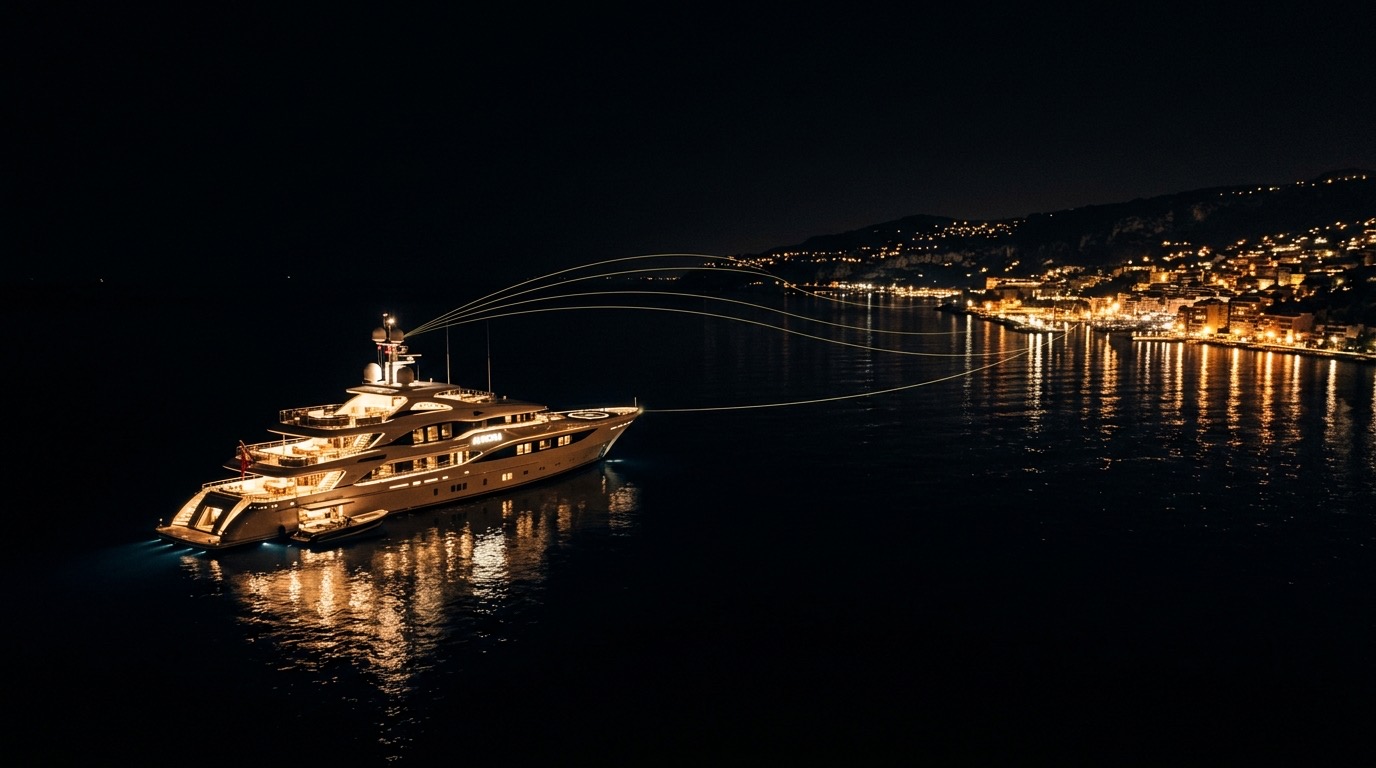
Superyacht Crew IT: The Network Beneath the Calm
A superyacht is a floating estate, a workplace, and a guest residence at once — each with its own demands on a single network. The vessels that feel effortless are the ones whose IT was designed to keep those worlds apart.

From the owner's stateroom, a superyacht feels seamless: the film streams, the call connects, the guest's laptop simply works. Beneath that calm sits one of the more demanding networks a private estate will ever operate — and the difference between a vessel that feels effortless and one that frustrates is almost always the quality of its yacht network and the superyacht crew IT that tends it.
The central challenge is that a yacht is several buildings at once. The owner's party expects flawless, private connectivity. Guests expect easy access. Crew need operational systems — navigation-adjacent tools, booking, payroll, maintenance logs — running independently of any of that. Putting them on one flat network is the single most common, and most dangerous, mistake at sea.
One Vessel, Several Networks
A well-designed yacht network is segmented, typically using VLANs, into isolated domains that share infrastructure without sharing trust:
- Owner network: prioritised for the fastest, most reliable bearer whenever the principal is aboard, and entirely walled off from every other domain.
- Guest network: generous and frictionless, with sensible bandwidth caps, but unable to see or reach owner or operational systems.
- Crew network: separate again, so personal crew devices never touch guest or owner traffic.
- Operational / vessel network: the most protected of all, isolating systems that keep the boat running.
This segmentation is not merely tidy engineering. It is the foundation of superyacht & jet cybersecurity: if a guest's infected phone joins the network, the damage is contained to a domain that holds nothing of value.
Connectivity That Does Not Drop
At sea, no single link is dependable. The resilient answer is a hybrid: low Earth orbit satellite such as Starlink Maritime for speed, geostationary VSAT for proven coverage, and 4G/5G when within reach of shore. Bonding equipment blends these bearers into one connection that self-corrects and fails over instantly — so the owner never sees the seam when the vessel passes out of cellular range and onto satellite.
A guest should never know which satellite is carrying their call. That invisibility is the entire point.
The Day-to-Day of Superyacht Crew IT
Designing the network is the easy part. Keeping it healthy through charter seasons, crew rotations, and the relentless saltwater environment is where most vessels struggle — and where dedicated superyacht crew IT earns its place. The daily reality includes:
Onboarding and offboarding
Crew turnover is high. Every departure must mean revoked access; every arrival, a correctly provisioned, managed device. Forgotten accounts are a standing liability.
Guest readiness
Before each charter or owner trip, the guest network is reset, capacities confirmed, and access made effortless — so the first impression is never a password problem.
Updates and monitoring
Routers, switches, and access points need patching; the network needs watching. Because the right partner can do most of this remotely, an issue is often resolved before anyone aboard notices it.
The chief stew or purser as first responder
Onboard staff are not IT professionals, and should not have to be. They need one number that answers, calmly, day or night.
One Standard, On Water and Off
A yacht does not exist in isolation. The principal moves between vessel, aircraft, and residence, and expects the same privacy in each. Treating onboard IT as part of a single posture — governed together across Yacht, Jet & Estate and underpinned by serious Personal Cybersecurity — is what turns a collection of devices into a genuinely private floating office.
The best superyacht IT is the kind no one aboard ever has to think about. The film streams, the call connects, the worlds stay apart — and the calm holds.
A Network Worthy of the Vessel
Start with a $4,999 Private Strategy Session, credited toward membership, and we will design and quietly maintain a yacht network built for owner, guest, and crew alike.
Request Your InvitationFrequently asked
Why does a superyacht need network segmentation?
Because a yacht serves owner, guests, and crew simultaneously, a single flat network lets any compromised device reach everything. Segmenting into separate VLANs - owner, guest, crew, and operational - contains threats, prioritises the owner's connection, and ensures a guest's infected laptop can never touch sensitive or vessel-critical systems.
What is the best internet setup for a superyacht?
A hybrid one. No single bearer is reliable at sea, so the strongest yacht networks bond low Earth orbit satellite (such as Starlink Maritime) for speed, geostationary VSAT for proven coverage, and 4G/5G near shore. Bonding hardware blends them into one self-correcting connection that fails over without the owner noticing.
Who manages IT on a superyacht day to day?
On most vessels there is no dedicated IT officer, so the chief stew, purser, or ETO becomes first responder. The practical solution is a specialist partner who manages updates, access, and monitoring remotely and provides one number that answers around the clock - so onboard staff are never left troubleshooting.
Can the same security cover my yacht, jet, and home?
Yes. Principals move between vessel, aircraft, and residence and expect consistent privacy in each. We govern all three as a single posture under our Yacht, Jet and Estate practice, applying the same segmentation, encrypted tunnels, device standards, and oversight everywhere - so the protection travels with you.