
The Watched Fleet: Yacht Tracking, AIS and the Limits of Privacy
Every large yacht announces itself by design, and an audience of millions has learned to listen. What follows is what an owner may lawfully withhold — and what must simply be managed.
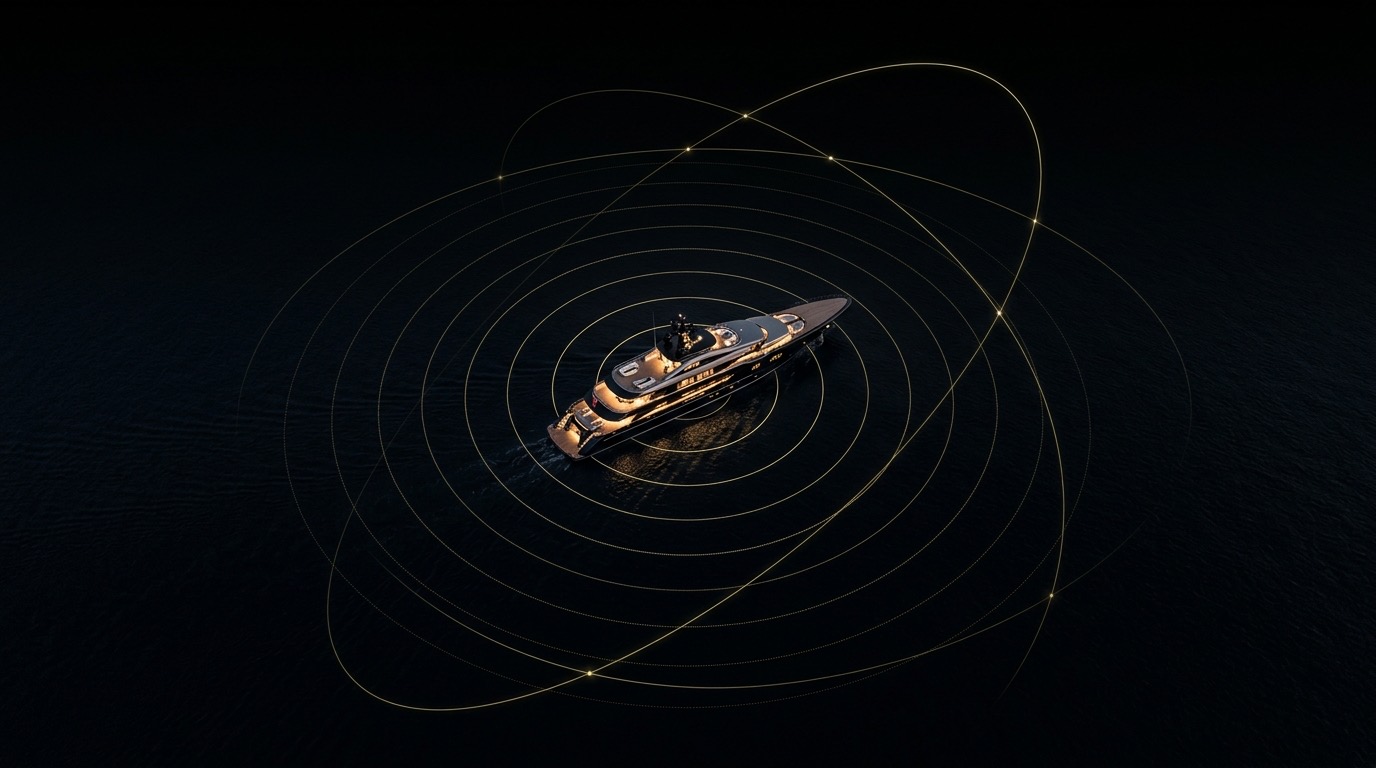
MarineTraffic, the largest of the public ship-tracking platforms, holds a database of more than 550,000 vessels, follows roughly 350,000 of them daily through a network of over 13,000 AIS receivers on land and in orbit, and records some 800 million vessel positions every month. Rival services — VesselFinder, ShipFinder and a long tail of free trackers — republish much the same feed. The consequence is plain: any person with a browser can locate most large yachts on Earth, in near real time, at no cost.
Around that raw feed has grown an enthusiast economy. Spotter accounts on Instagram chronicle arrivals in Monaco and Palma; directories such as SuperYachtFan pair hull names with presumed owners; and when a technology founder's 118-metre flagship went quiet on the trackers, the act of going dark itself became the story, covered from Seattle to the Gulf. For a principal, the vessel is frequently the most visible object they own — more legible to strangers than their house, their aircraft or their diary.
Why AIS Was Never Built for Privacy
The Automatic Identification System exists for collision avoidance, not concealment. Under the SOLAS Convention, AIS is mandatory for vessels of 300 gross tonnage and over on international voyages, and for passenger ships regardless of size — a net that captures effectively every superyacht and every vessel in commercial charter. The transponder broadcasts identity, position, course and speed in clear over VHF; coastal stations and satellites do the rest. The system presumes co-operation and offers essentially no confidentiality by design.
SOLAS Regulation V/19 requires AIS to be kept in operation at all times, with a narrow exception: the master may switch off or reduce the transmission where its operation might compromise the safety or security of the ship — a credible piracy threat off the Horn of Africa, for instance — and the decision is to be recorded in the logbook and resumed when the danger passes. That exception is a security instrument, not a privacy setting. Using it to dodge photographers in the Gulf of Saint-Tropez invites flag-state scrutiny, insurance complications and, ironically, attention: on satellite AIS, a large yacht that vanishes is more conspicuous than one that does not.
What May Lawfully Be Done
A good deal, as it happens — provided the work is done at the level of data, not transmission. Smaller yachts below the SOLAS threshold and outside passenger service may carry Class B transceivers voluntarily, with more latitude in how they are operated. For vessels that must transmit, the lawful terrain lies elsewhere: in what the broadcast is allowed to mean.
MMSI and call-sign registrations need not be filed in a beneficial owner's name; holding them through the owning SPV or management company, as is standard practice, keeps the registry trail corporate. Several commercial tracking platforms operate removal or masking programmes through which a vessel's photographs, particulars or historical track can be suppressed from public view on request — imperfect, since the underlying AIS remains receivable, but materially raising the cost of casual surveillance. Charter managers can be instructed to keep the vessel out of public charter-fleet listings and to market it discreetly, broker to client. And names matter: a hull that shares its name with the family vehicle invites the join; a neutral name resists it.
The Vessel's Wider Digital Footprint
AIS is only the loudest channel. The vessel leaks elsewhere: crew who geotag the aft deck on Instagram; shipyard press releases; classification-society records; marina webcams; charter brochures with deck plans; the tender's consumer chartplotter quietly reporting to a fitness app. An adversary — or merely a determined fan — assembles these fragments into pattern-of-life: where the family summers, when the boat is unattended, which week the principal is reliably aboard. The same open-source mosaic that enables convincing impersonation of executives begins, for many families, with the boat. The discipline of mapping and pruning that mosaic is central to our cybersecurity practice, and to the standing arrangements described in concierge IT.
The sea grants no anonymity to those who broadcast; it grants discretion to those who manage what the broadcast reveals.
A Counter-Surveillance Posture, Not a Switch
The honest counsel is that a SOLAS-class yacht cannot be hidden, and attempting to hide it is both unlawful in ordinary circumstances and counter-productive. What it can be is hardened: registry details held corporately, tracking-platform suppressions in place, charter listings curated, crew social-media protocols enforced, and the vessel's connectivity — the subject of our notes on Starlink aboard and yacht and jet cybersecurity — segmented and monitored so the boat's electronic emissions are as disciplined as its wake.
This is precisely the work a private office does well: a full digital-footprint review of the vessel and the family around it, conducted remotely and under NDA; the lawful suppressions and registry hygiene executed with managers and counsel; and continuous monitoring thereafter, so that when a spotter account or a tracking site surfaces something new, the owner hears it first — quietly, and before anyone else has noticed.
Know What the World Sees
Obsidian Helm conducts vessel digital-footprint reviews and lawful tracking-exposure audits remotely, worldwide, under NDA. Engagement begins with a $4,999 Private Strategy Session, credited in full toward membership.
Request Your InvitationFrequently asked
Can anyone really track a superyacht for free?
Yes. Platforms such as MarineTraffic and VesselFinder republish AIS broadcasts that vessels transmit by design, covering hundreds of thousands of ships daily through terrestrial and satellite receivers. Anyone with a browser can see a yacht's position, course, speed and port history in near real time, and enthusiast accounts actively follow notable hulls.
Is it legal to turn off a yacht's AIS transponder?
Generally no. SOLAS requires AIS to operate at all times on vessels of 300 gross tonnage and over on international voyages and on all passenger ships. The sole exception lets the master suspend transmission where it would endanger the ship's safety or security, such as a piracy threat, with the decision logged and transmission resumed afterward.
How can a yacht owner reduce tracking exposure without breaking the law?
Lawful measures work on the data, not the transmitter: register MMSI and call sign through the owning company rather than personally, request photo and track suppression from commercial tracking platforms, keep the vessel out of public charter listings, choose a neutral hull name, and enforce crew social-media discipline. Together these sharply raise the cost of casual surveillance.
What gives away a yacht owner's movements besides AIS?
Plenty. Crew geotagging posts, marina webcams, shipyard and charter publicity, classification records, paparazzi and spotter communities, and even consumer apps aboard tenders all leak position and pattern-of-life. A serious privacy review treats AIS as one channel among many and maps the vessel's entire open-source footprint before deciding what to prune.