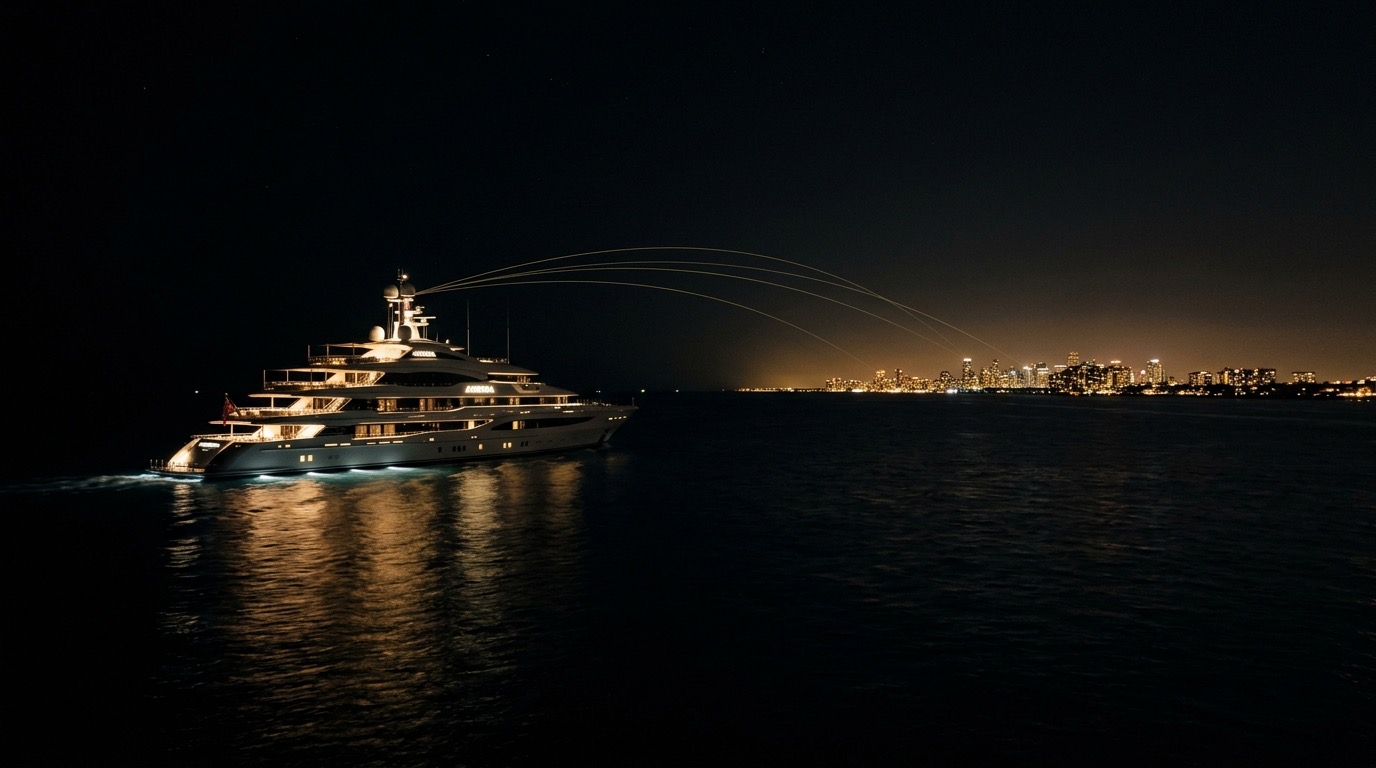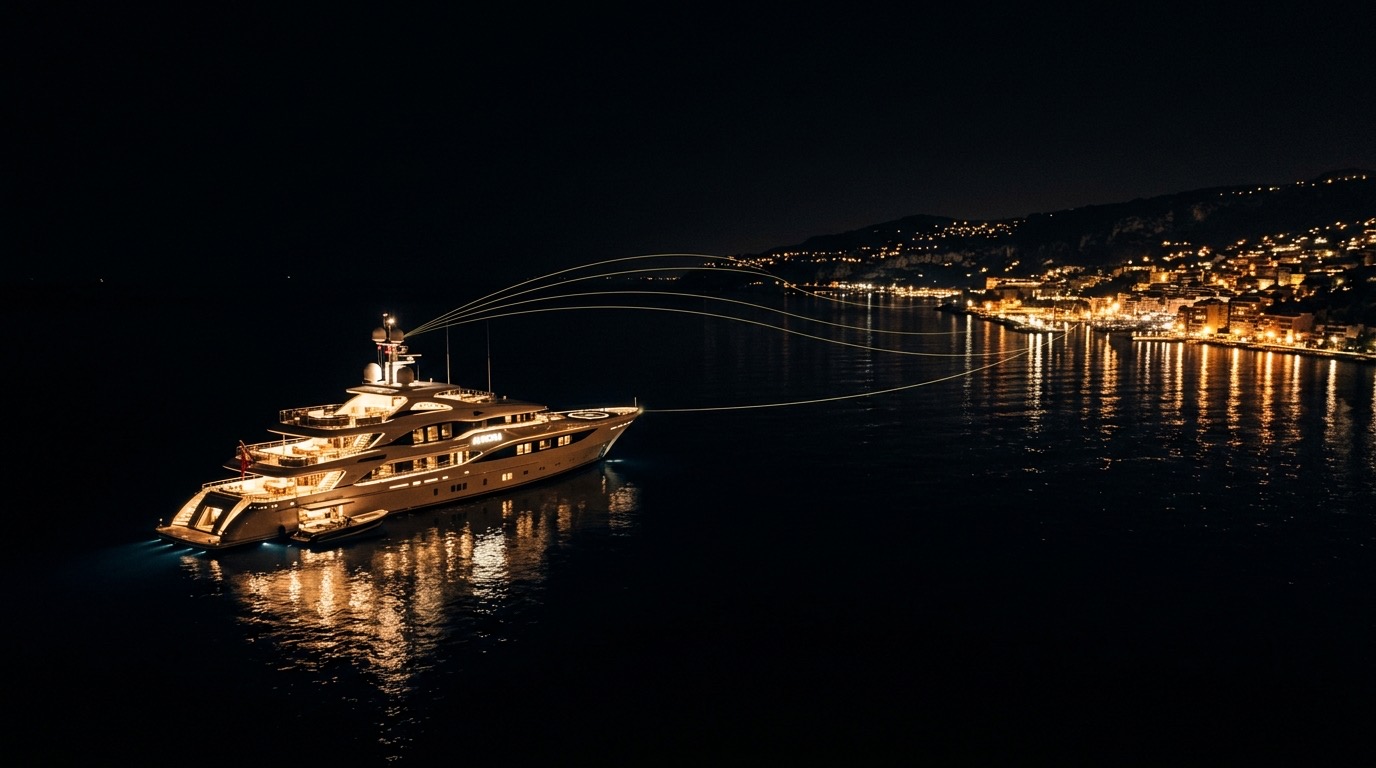
Cannes & Antibes: Superyacht IT for the Festival Coast
Between the Croisette's red carpet and Port Vauban's Billionaires' Quay lies the densest concentration of large yachts in Europe — and the most demanding few miles of coastline a yacht's network will ever serve.
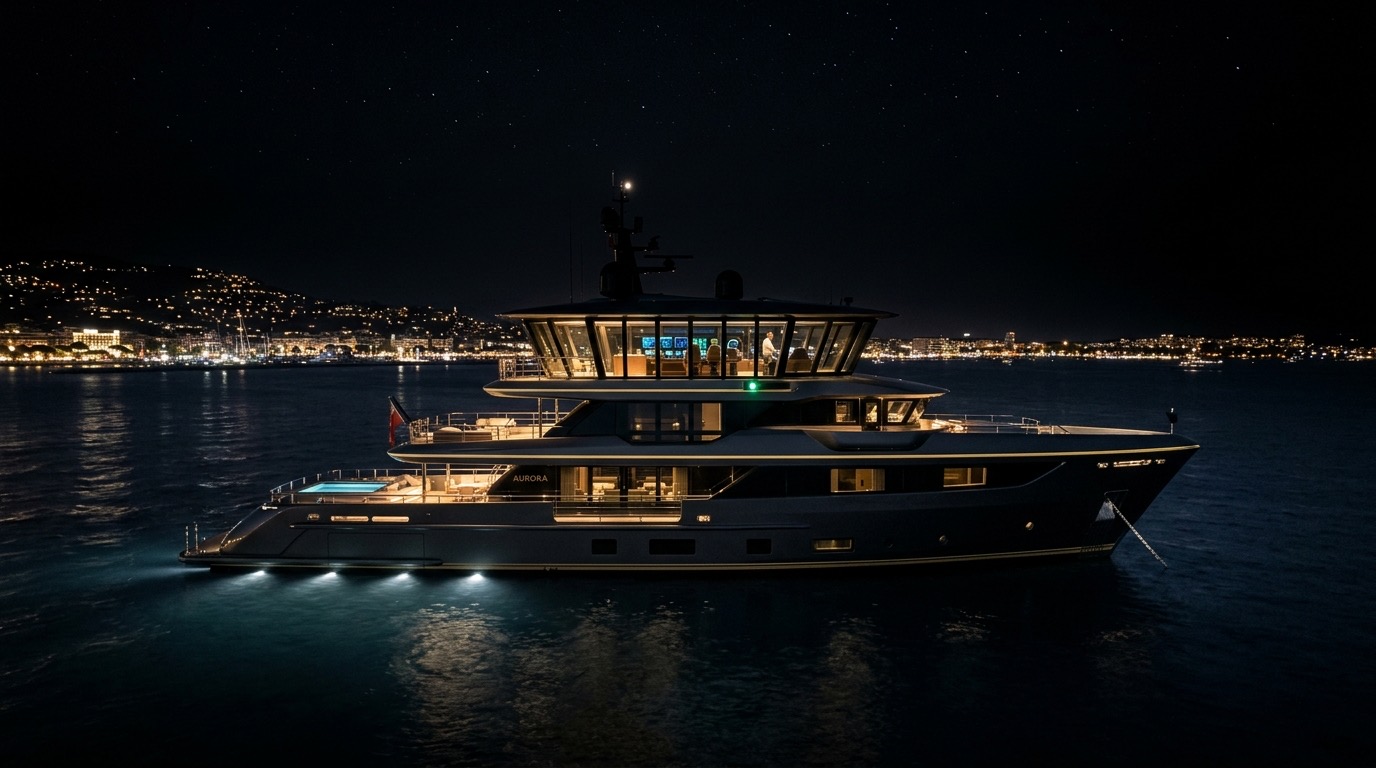
No stretch of coastline asks more of a yacht than the seven nautical miles between Cannes and Antibes. Port Vauban — with roughly 1,500 berths, capacity for yachts to 160 metres and the storied Quai des Grande Plaisance, known since 1986 as the Billionaires’ Quay — remains the largest superyacht marina in Europe, freshly reimagined through a €135 million redevelopment of the International Yacht Club of Antibes. A few minutes west, the Vieux Port de Cannes hosts the Cannes Yachting Festival each September: some 710 boats, 680 exhibitors and 56,000 visitors compressed into six days on the water.
And that is merely the autumn. In May, the Cannes Film Festival turns the bay into a floating annexe of the Palais; in June, Cannes Lions fills the same anchorage with chartered yachts operating as corporate boardrooms, broadcast studios and deal rooms. For ten weeks a year, a yacht off the Croisette is not a leisure asset. It is critical infrastructure — and it is being watched.
The festival problem: when the anchorage becomes a newsroom
During Film Festival and Lions weeks, the radio spectrum off Cannes is among the most contested in the Mediterranean. Hundreds of vessels, thousands of journalists, temporary cell masts straining under load — and, less visibly, rogue access points spun up within range of the anchorage, named after yachts and brands, waiting for a guest’s phone to join. A principal hosting studio executives aboard during the festival is one careless connection away from a leaked term sheet.
The defence is unglamorous and absolute: hardened network segmentation. Owner, guest, crew and bridge traffic ride physically and logically separate networks, so a compromised influencer’s laptop on the guest VLAN can never reach the owner’s correspondence or the vessel’s navigation and AV systems. We design and operate that segmentation remotely, audit it before the season, and watch it — quietly, continuously — while the party is on deck. The same architecture underpins our wider Yacht & Jet practice, and the principles are set out in our superyacht and jet cybersecurity briefing.
Port Vauban: the homeport audit
Antibes is where the Mediterranean fleet winters, refits and changes crew — which makes it where yacht networks quietly decay. Contractors plug into switches and leave configurations behind. Departing ETOs take institutional knowledge with them; arriving ones inherit undocumented systems. A berth on the IYCA quay, metres from a dozen other large yachts and an open quayside, is a far more exposed network position than mid-ocean.
A homeport period is therefore the natural moment for a full audit: firmware across every switch and access point, VPN and firewall rules, shore-power-adjacent shore connections, CCTV and access-control systems, and the slow accretion of crew devices on the wrong network — a risk we examine in detail in our guide to crew networks and onboard IT discipline. The work is done remotely, under NDA, with no visible team aboard; to the dock, nothing happened at all.
Connectivity engineered for the bay, not the brochure
Festival weeks expose the gap between advertised and actual bandwidth. Coastal LTE saturates precisely when your guests need it; marina Wi-Fi is best treated as hostile. The serious answer is layered: maritime Starlink as the primary path, 4G/5G aggregation across multiple carriers as the second, and VSAT retained where the vessel’s charter commitments justify it — all orchestrated by failover logic that shifts traffic in seconds, invisibly. We’ve written a fuller technical treatment in our Starlink at sea briefing and the broader yacht Wi-Fi guide.
Bandwidth, however, is the easy half. Priority is the hard half: the owner’s video call outranks the deck crew’s streaming; the broker’s wire instructions outrank everything. Quality-of-service design is where a yacht network stops being an amenity and becomes an instrument.
On this coast, the yachts are photographed from every angle. The network should be the one thing nobody ever sees.
The charter dimension
Cannes-based charter yachts carry a particular burden: every booking imports a new set of unknown devices, and every disembarkation should trigger a guest-network purge — credentials rotated, device lists cleared, logs reviewed. Few operations do this with discipline. Fewer still extend the same rigour to the AV and IoT layer: lighting, blinds, entertainment systems that are, in effect, small computers with long-forgotten passwords. Our cybersecurity office treats them as the attack surface they are.
Obsidian Helm operates as a private technology office — by invitation, fully remote, under NDA, with engineering provenance dating to 2014 through IT Cares Canada. We do not put a team in branded polos on your passerelle in front of the festival cameras. We make the systems beneath your season — from a May premiere off the Croisette to a September berth at Vauban — quietly unassailable, as we do across the wider Mediterranean circuit.
Before the next festival season
Begin with a Private Strategy Session — $4,999, fully credited toward membership. One confidential conversation, a complete read of your vessel's digital posture, and a plan before the bay fills again.
Request Your InvitationFrequently asked
Why do superyachts in Cannes need dedicated cybersecurity?
During the Film Festival, Cannes Lions and the Yachting Festival, the bay concentrates high-value targets, saturated networks and opportunistic attackers in one anchorage. Yachts hosting executives or talent carry sensitive deals, scripts and correspondence aboard. Segmented networks, monitored traffic and hardened guest Wi-Fi prevent a single compromised device from exposing the owner's affairs.
Is Port Vauban in Antibes safe for a yacht's network?
Port Vauban is superbly run, but any berth among 1,500 others is an exposed network position. Open quaysides, contractor access during refits and dense radio spectrum all raise risk compared with being at anchor offshore. A homeport stay is the ideal moment for a full network and firmware audit before the season.
What internet setup works best for festival weeks in Cannes?
Layered connectivity: maritime Starlink as the primary link, multi-carrier 4G and 5G aggregation as backup, and automated failover between them. Coastal mobile networks saturate during the Film Festival and Cannes Lions, so a yacht relying on LTE alone will struggle precisely when guests are aboard and expectations are highest.
Can yacht IT support be delivered without a team coming aboard?
Yes. Nearly all design, monitoring, hardening and incident response can be performed remotely once the vessel's network is properly instrumented. Obsidian Helm operates this way deliberately: fully remote, under NDA, with no visible presence aboard, so the owner's privacy and the yacht's discretion are never compromised by the support itself.