
Charter WiFi Without Compromise: Serving Guests, Protecting the Owner
Connectivity now sells charters as surely as the sundeck. The discipline lies in delivering it to strangers, week after week, without ever handing them the vessel itself.
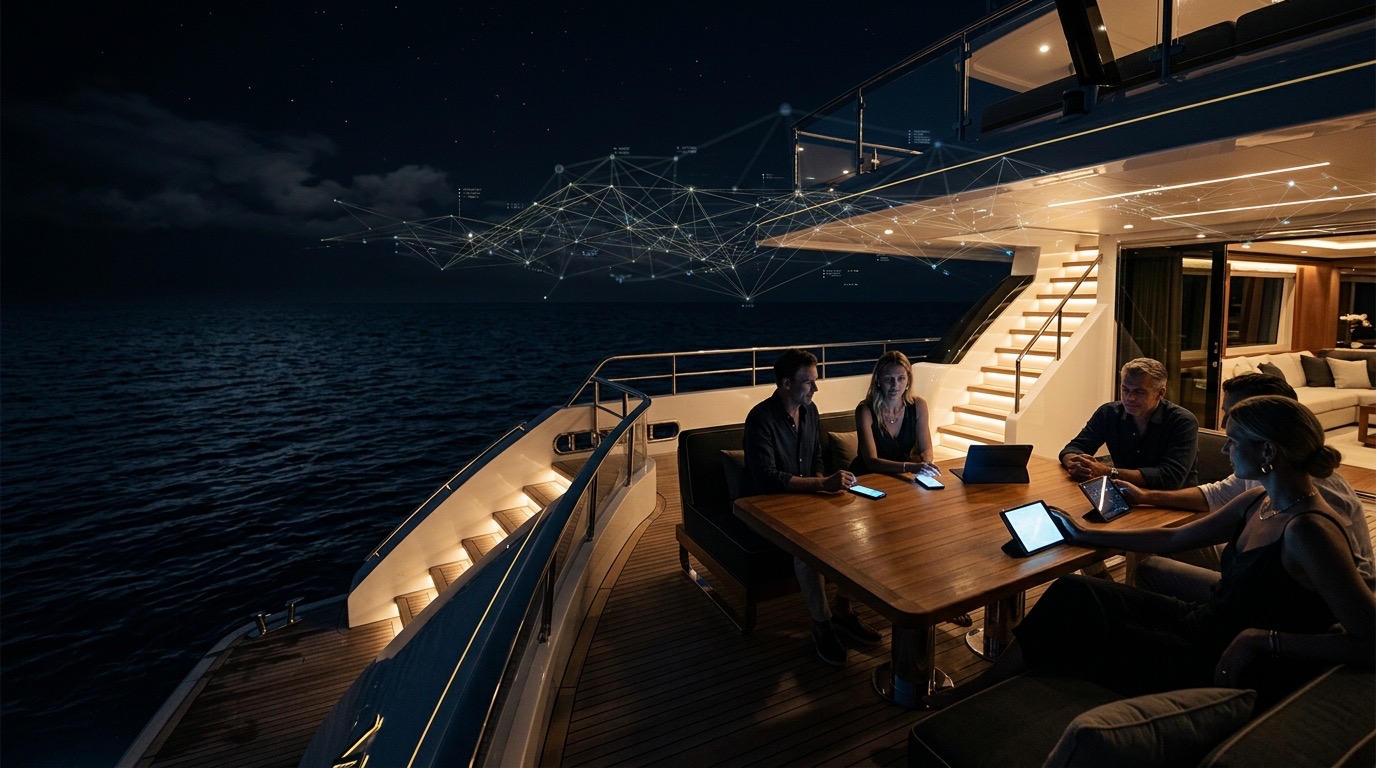
The global yacht charter market was valued at roughly $9 billion in 2025 and is projected to double to more than $18 billion by 2034, with Europe alone commanding close to seventy per cent of bookings. Behind those figures sits a quieter shift in what the charter client actually buys. A decade ago the conversation was cabins, crew and itinerary. Today, brokers report that connectivity questions arrive before the wine list. A family of six boards with upwards of thirty devices among them — phones, tablets, laptops, watches, consoles — and expects each one to behave as it would in a Mayfair townhouse.
The technology has, in fairness, caught up. Starlink installations on yachts now routinely deliver between 100 and 450 Mbps down, with professional fleets pairing the dish with 4G/5G failover and enterprise routing so that a cloudburst off Sardinia does not interrupt a principal's video call. We have written separately about what Starlink actually changes aboard; this piece concerns what it changes for the owner who charters. Because the same bandwidth that delights a guest is, unmanaged, a corridor running straight into the owner's private world.
What the Charter Guest Now Expects
Charter clients are no longer forgiving of maritime exceptions. They expect 4K streaming in every cabin, lag-free calls from the sky lounge, uploads of drone footage before lunch, and a working VPN for the family office back home. Brokers have responded by listing connectivity in the vessel's specification sheet alongside the tender garage — and a yacht that cannot evidence it loses weeks. The commercial logic is unarguable. At €500,000 or more per week for a large vessel, no owner wishes to lose a booking over wifi.
What the specification sheet rarely records is how that wifi is segmented. On too many vessels, the answer is: barely. Guest devices, crew devices, the AV system, CCTV, door access, navigation electronics and the owner's own equipment share infrastructure that was designed for coverage, not containment. The arrangement is invisible right up until it matters.
The Owner's Problem Nobody Discusses
A charter season is, from a security standpoint, a rotating cast of unvetted endpoints. Each week brings new guests, new devices, new apps of unknown provenance — and occasionally a guest whose phone is already compromised before it reaches the passerelle. None of this requires malice. A teenager's laptop carrying commodity malware, joined to a flat network, can scan everything the network can see: the NAS holding the owner's photographs, the CCTV server, the integration PC that talks to the bridge.
The exposure compounds because the vessel is also a workplace. Crew handle the owner's calendar, provisioning accounts and financial instructions over the same infrastructure — a subject we treat in detail in our note on crew networks and IT discipline. When guest, crew and owner traffic intermingle, a single careless join undoes the discretion the owner pays handsomely to maintain everywhere else, a theme that runs through the whole of our yacht, jet & estate practice.
Week-by-Week Network Hygiene
The remedy is neither exotic nor burdensome. It is a discipline, executed between every charter with the same rigour as the deep clean.
The Turnaround Checklist
Properly run, each turnaround includes: rotation of the guest SSID and passphrase, so last week's guests carry nothing forward; a purge of the guest VLAN, with every device de-registered; a review of DNS and firewall logs for anything that beaconed somewhere it should not; firmware and patch checks on routers and access points; and confirmation that guest wifi remains strictly isolated — able to reach the internet and nothing else. The owner's segment and the vessel's operational technology should be invisible from a guest cabin, not merely password-protected. Captains who want the fuller architecture will find it in our yacht wifi field guide.
Bandwidth governance belongs here too. Per-cabin fair-use shaping prevents one guest's 4K habit from degrading another's call, and prevents the ETO from improvising network changes mid-charter — improvisation being where most security regressions are born.
A charter guest should remember the connection. The connection should not remember the guest.
When the Broker Asks
Increasingly, the demand cuts both ways. Sophisticated brokers and charterers' family offices now ask what the vessel does with guest data, whether browsing is logged, and who can see it. An owner able to answer crisply — isolated guest network, no content inspection, logs held briefly for security alone, infrastructure independently reviewed — turns security from a cost into a selling line. It is the same posture we recommend across an owner's footprint in our cybersecurity practice: discretion, evidenced.
This is work best done quietly, remotely and under NDA — an architecture review before the season, segmentation properly enforced, monitoring that watches the vessel year-round without ever inconveniencing a guest, and a turnaround protocol the crew can execute in an hour. The owner notices nothing except that nothing ever goes wrong; the charterer notices only that the wifi is, at last, beyond reproach.
Before the Season Begins
Obsidian Helm reviews charter-vessel networks remotely and under NDA — segmentation, guest isolation, turnaround protocol and year-round monitoring. Engagement begins with a $4,999 Private Strategy Session, credited in full toward membership.
Request Your InvitationFrequently asked
What internet speed should a charter yacht offer guests?
Modern charter guests expect performance comparable to a good home connection. Starlink installations on yachts commonly deliver 100 to 450 Mbps download, enough for simultaneous 4K streaming and video calls. Serious charter vessels pair satellite with 4G or 5G failover and professional routing so coverage holds in marinas, at anchor and on passage.
Can charter guests access the yacht's own systems through the wifi?
On a properly segmented network, no. Guest wifi should sit on an isolated VLAN that reaches the internet and nothing else, with the owner's devices, CCTV, AV and navigation electronics on separate segments. On flat networks without that isolation, any guest device can potentially scan and reach onboard systems, which is the principal risk owners overlook.
Should the wifi password change between charters?
Yes. Rotating the guest network name and passphrase at every turnaround ensures departed guests retain no access and their devices cannot silently rejoin in port. The same turnaround should purge registered devices from the guest segment, review logs for anomalies and apply pending firmware updates, treated as routinely as the deep clean.
Do charter brokers really ask about yacht connectivity and security?
Increasingly, yes. Connectivity now appears on specification sheets alongside tenders and toys, and brokers report guests asking about wifi before cabin layouts. Charterers' family offices may also ask how guest data is handled and whether browsing is logged. Owners who can evidence isolated guest networks and an independent review gain a genuine commercial edge.